MBA in Berlin
Table of Contents
- Top Business Schools for MBA in Berlin, Germany
- MBA Curriculum and Course Structure
- Eligibility and Admission Requirements for MBA in Berlin, Germany
- Cost of MBA in Berlin, Germany
- Top Scholarships for MBA in Berlin, Germany
- Intakes and Application Timeline for MBA in Berlin, Germany
- How to Apply for MBA in Berlin, Germany
- Student Visa Requirements for MBA in Berlin, Germany
- Work Opportunities While Studying MBA in Berlin, Germany
- Career Opportunities After MBA in Berlin, Germany
- Author's POV
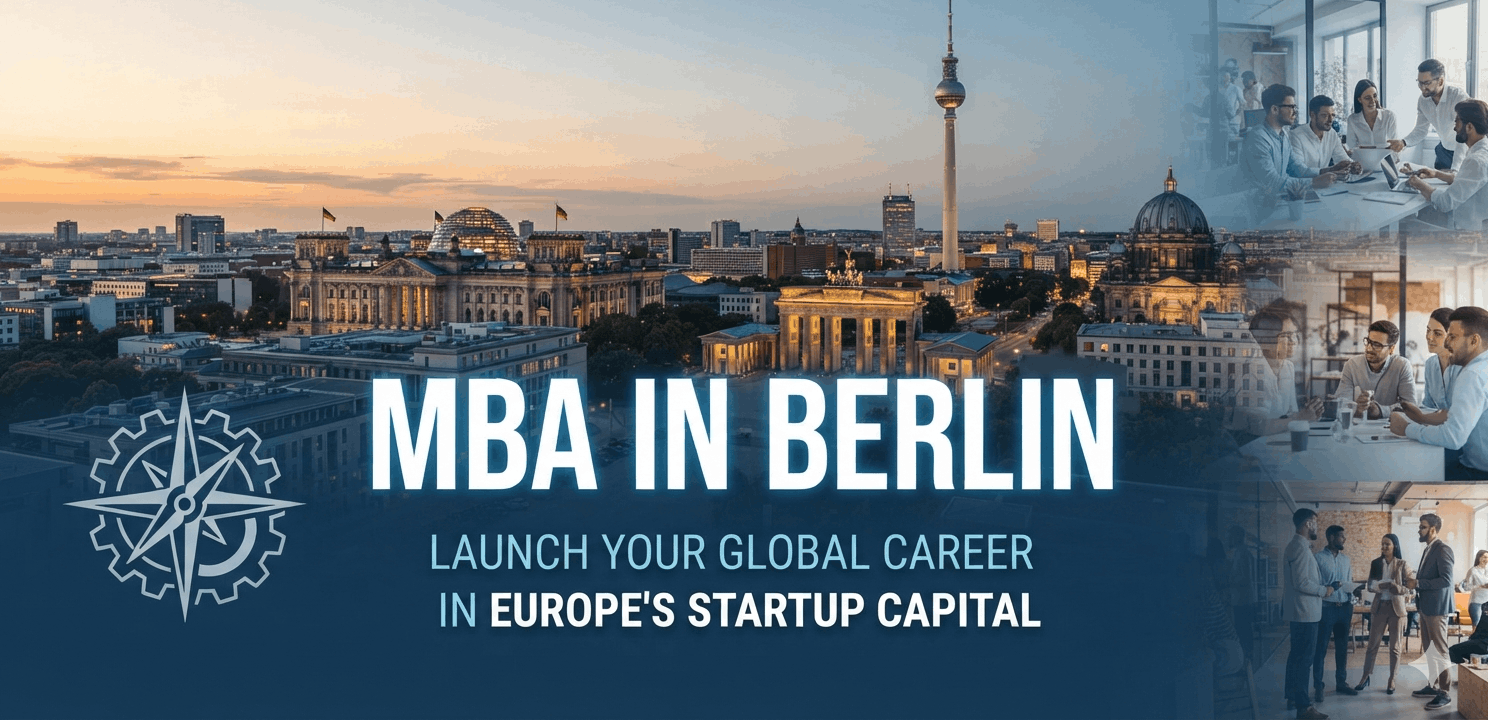
Choosing an MBA in Berlin, Germany gives you the opportunity to study in one of Europe's fastest-growing business and innovation hubs. Known for its thriving startup ecosystem, global corporations, and affordable education, Berlin attracts ambitious professionals from around the world.
Many universities offer English-taught MBA programmes that combine classroom learning with practical industry exposure through internships, consulting projects, and networking events. Compared to other major study destinations, Berlin also offers a relatively lower cost of living while providing excellent career opportunities after graduation. If you're looking to build an international career, an MBA in Berlin, Germany is a smart and future-focused investment.
Key Highlights: MBA in Berlin, Germany
Key Highlights | Details |
Primary Institution | ESMT Berlin (European School of Management and Technology) |
Programme Duration | 1 year full-time MBA; part-time and online formats available |
Degree Awarded | Master of Business Administration (MBA) |
Accreditation | Triple Crown: AACSB, AMBA, and EQUIS |
Approx. Annual Tuition Fee | EUR 53,500 total for full-time MBA (approx. Rs. 48.15L total) |
FT Ranking | Number 1 business school in Germany; top 8 in Europe |
QS MBA Ranking 2026 | #62 globally |
Core Focus Areas | Leadership, Innovation, Analytics, Entrepreneurship, Digital Transformation |
Work Experience Required | 3 to 5 years preferred for full-time MBA |
Post-Study Work Option | 18-month job search visa after graduation |
Career Outcomes | Management Consultant, Strategy Manager, Technology Manager, Entrepreneur |
Scholarship Options | ESMT merit scholarships, DAAD, Women in Leadership awards |
Top Business Schools for MBA in Berlin, Germany
The leading MBA colleges in Berlin cater to a wide range of career goals, budgets, and learning preferences. While ESMT Berlin is widely recognised for its global rankings and triple accreditation, the city is also home to several other respected institutions offering full-time, part-time, and executive MBA programmes.
Each business school brings its own strengths, whether in entrepreneurship, technology, sustainability, or international business, allowing students to choose a programme that best aligns with their professional ambitions.
Business School | Approx. Tuition |
ESMT Berlin | EUR 53,500 total full-time MBA (approx. Rs. 48.15L) |
Berlin School of Economics and Law (HWR Berlin) | EUR 15,000–25,000 (approx. Rs. 13.5L–Rs. 22.5L) |
Steinbeis University Berlin | EUR 18,000–30,000 (approx. Rs. 16.2L–Rs. 27L) |
SRH Berlin University of Applied Sciences | EUR 12,000–20,000 (approx. Rs. 10.8L–Rs. 18L) |
Freie Universität Berlin (School of Business) | EUR 0 tuition (public university); semester fee applies |
MBA Curriculum and Course Structure
Before choosing an MBA programme, it's worth understanding how the curriculum is designed and whether it matches your career goals. Most MBA programmes in Berlin combine core business concepts with practical learning, allowing students to build leadership skills while working on real business challenges. For example, ESMT Berlin offers a one-year full-time MBA that blends classroom learning with consulting projects, teamwork, and industry engagement.
Core Programme Curriculum
The first part of the programme focuses on building a strong foundation in business management. Students study subjects such as leadership, strategy, finance, marketing, operations, and business analytics while developing problem-solving and decision-making skills. Reflecting Berlin's reputation as a technology and startup hub, many MBA programmes also place a strong emphasis on innovation, digital transformation, and entrepreneurship from the very beginning.
Programme Stage | Key Components |
Leadership and Organisational Behaviour | Leadership styles, team dynamics, change management, ethics |
Strategy and Corporate Policy | Competitive analysis, strategic planning, corporate governance |
Financial Management | Corporate finance, financial modelling, valuation, capital allocation |
Marketing Management | Consumer behaviour, brand strategy, digital marketing, customer analytics |
Analytics and Data-Driven Decision Making | Business analytics, statistical tools, data visualisation, AI applications |
Innovation and Entrepreneurship | Venture creation, startup strategy, innovation management, digital transformation |
Consulting Project or Capstone | Live client project with corporate partner or applied research dissertation |
MBA Formats Available in Berlin
ESMT Berlin offers multiple MBA formats designed for different career stages and study preferences. Understanding which format suits the student's professional background and availability is the first practical decision before applying.
Format | Duration | Target Applicant |
Full-Time MBA | 1 year | Professionals seeking full career transition |
Part-Time MBA | 2 years | Working professionals in Germany |
Global Online MBA | Flexible | International professionals studying remotely |
Executive MBA | 15 to 18 months | Senior professionals with 10 or more years of experience |
Popular Specialisations in MBA in Berlin, Germany
Specialisation electives at ESMT Berlin allow students to focus their training on a specific industry or function. Berlin's startup ecosystem and ESMT's founding company relationships create particularly strong specialisation tracks in entrepreneurship, analytics, and technology management.
Specialisation | Focus Areas |
Entrepreneurship and Innovation | Startup strategy, venture creation, ecosystem navigation, funding models |
Analytics and Artificial Intelligence | Machine learning applications, data governance, AI strategy, analytics tools |
Technology and Digital Transformation | Digital business models, platform strategy, IT management, tech-enabled leadership |
Finance and Investment | Corporate finance, investment management, financial modelling, M&A |
Strategy and Consulting | Consulting methodology, strategic analysis, client engagement, process improvement |
Sustainability and Responsible Leadership | ESG strategy, circular economy, corporate responsibility, impact management |
Must check: Higher Studies after MBA in Abroad 2026
Eligibility and Admission Requirements for MBA in Berlin, Germany
Getting into an MBA programme in Berlin involves more than meeting academic criteria. Universities look for candidates who demonstrate leadership potential, relevant work experience, and clear career goals. For an Executive MBA in Berlin, Germany, applicants are generally expected to have several years of professional experience. Admissions committees also evaluate your academic background, English language proficiency, and, in some cases, GMAT or GRE scores.
Academic Qualification Requirements
Most universities require applicants to hold a bachelor's degree from a recognised institution. However, academic qualifications are only one part of the selection process. Many Berlin business schools place equal, or even greater, emphasis on your professional experience, leadership skills, and career progression to determine whether you're a good fit for their MBA programme.
Business School Tier | Academic Expectations |
ESMT Berlin (Full-Time MBA) | Bachelor's degree from a recognised institution; strong academic standing; 3 to 5 years of professional experience strongly preferred |
ESMT Berlin (Executive MBA) | Bachelor's degree; minimum 10 years of senior professional experience required |
Mid-Tier Berlin Schools (HWR, Steinbeis) | Bachelor's degree with solid academic performance; 2 to 3 years of work experience valued |
Public Universities (Freie Universität) | Recognised undergraduate degree; academic merit assessed; no tuition fees |
English Language Requirements
All ESMT Berlin MBA programmes are taught entirely in English, and non-native speakers must demonstrate proficiency through a recognised test. ESMT Berlin is described as the most international business school in Germany, with over 80 percent of faculty members from non-German backgrounds.
School | IELTS Academic | TOEFL iBT |
ESMT Berlin | 6.5 or above | 90 or above |
HWR Berlin | 6.0 to 6.5 | 79 to 90 |
Steinbeis University | 6.0 to 6.5 | 79 to 90 |
SRH Berlin | 6.0 | 79 to 80 |
GMAT, GRE, and Other Admission Requirements
GMAT scores are required or recommended at ESMT Berlin for the full-time and executive MBA formats. The school also places significant weight on a coherent career narrative, essay quality, and interview performance alongside quantitative test scores.
Requirement | Detail |
GMAT or GRE | Required or strongly recommended at ESMT Berlin; competitive GMAT range 600 to 680 or above |
Application Essays | Outlines career goals, leadership experience, and specific reasons for choosing the programme |
Letters of Recommendation | Two to three professional references; direct managers strongly preferred |
CV or Resume | Academic background, work experience, leadership roles, and relevant achievements |
Work Experience | 3 to 5 years preferred; management or analytical exposure valued at ESMT |
Interview | Required at ESMT Berlin and most competitive Berlin programmes |
Cost of MBA in Berlin, Germany
While an MBA in Berlin, Germany free of tuition is uncommon, some public universities and scholarship-funded programmes can significantly reduce your overall study costs. Even for paid programmes, the total cost of studying in Berlin, including tuition and living expenses, is generally lower than in cities such as London, Paris, or New York.
Tuition Fees for MBA in Berlin, Germany
ESMT Berlin's full-time MBA total tuition of EUR 53,500 (Rs. 48.15L) sits considerably below comparable one-year European MBA programmes at LBS, INSEAD, or HEC Paris while still delivering Triple Crown accreditation and top European rankings. Other Berlin schools offer MBA programmes at lower price points with more regional employer focus.
Business School | Programme | Approx. Total Tuition |
ESMT Berlin | Full-Time MBA (1 year) | EUR 53,500 (Rs. 48.15L) total |
ESMT Berlin | Part-Time MBA (2 years) | EUR 40,000 (Rs. 36L) total |
ESMT Berlin | Global Online MBA | EUR 23,800 (Rs. 21.42L) total |
ESMT Berlin | Executive MBA | EUR 59,500(Rs. 53.55L) total |
HWR Berlin | MBA | EUR 15,000–25,000/ (Rs. 13.5L–Rs. 22.5L) year |
Steinbeis University | MBA | EUR 18,000–30,000/(Rs. 16.2L–Rs. 27L) year |
Cost of Living in Berlin for MBA Students
Berlin is considerably more affordable than London, Paris, or Amsterdam for day-to-day living. Among European capital cities, Berlin consistently offers one of the best combinations of quality of life and manageable living costs, which reduces the total financial investment required to complete an MBA here compared to most Western European alternatives.
Expense Category | Berlin (Monthly) | INR Value |
Accommodation | EUR 700–1,200 | Rs. 63,000–Rs. 1.08L |
Food and Groceries | EUR 250–400 | Rs. 22,500–Rs. 36,000 |
Transport | EUR 86–100 (monthly transit pass) | Rs. 7,740–Rs. 9,000 |
Health Insurance | EUR 110–120/month | Rs. 9,900–Rs. 10,800 |
Books and Personal Expenses | EUR 150–300 | Rs. 13,500–Rs. 27,000 |
Total Annual Living Cost | EUR 15,000–24,000 | Rs. 13.5L–Rs. 21.6L |
Source: Numbeo
Top Scholarships for MBA in Berlin, Germany
Several scholarship options are available for international students pursuing MBA in Berlin, Germany . ESMT Berlin offers merit-based scholarships reviewed as part of the admissions process, while government-funded options through DAAD and foundation scholarships provide additional funding routes for qualifying applicants.
Scholarship | Eligibility | Coverage |
ESMT Berlin Merit Scholarships | Admitted to ESMT MBA; strong academic record, leadership potential, and professional achievement; self-funded candidates only | Applied directly to tuition; partial tuition reduction; varies by award |
ESMT Women in Leadership Scholarship | Female applicants admitted to ESMT MBA; demonstrated leadership potential and professional achievement | Partial tuition reduction; varies by award |
DAAD Scholarships | International students; strong academic record; various programme tracks | Approx. EUR 861–1,200/month (approx. Rs. 77,490–Rs. 1.08L/month) stipend |
Konrad-Adenauer-Stiftung | Strong academic record and civic engagement; open to international students | Monthly stipend plus study allowance |
Heinrich Böll Foundation | Academic merit and social engagement; open to international applicants | Monthly stipend; varies by programme |
Friedrich Ebert Foundation | Academic merit; socially engaged students; open to international applicants | Monthly stipend plus additional allowances |
Intakes and Application Timeline for MBA in Berlin, Germany
ESMT Berlin's full-time MBA primarily follows a single annual intake in September, with a round-based application system that rewards early applicants with stronger scholarship consideration and admission outcomes. Understanding which round to target is as important as the quality of the application itself.
Intake | Programme Start | Application Timeline |
September Intake (Main) | September | Applications open year-round; multiple rounds from October to June |
Rolling Admissions | Variable | ESMT reviews applications on a rolling basis; earlier applications receive strongest consideration |
Note:
· The September intake is the primary and only standard entry point for the full-time MBA in Berlin, Germany, and ESMT Berlin operates rolling admissions within this cycle rather than rigid fixed rounds.
· Applying early, ideally between October and February for September entry, consistently produces better outcomes for both admission and scholarship consideration.
· Students who apply later in the cycle may still be admitted but face reduced scholarship availability and smaller available cohort places.
How to Apply for MBA in Berlin, Germany
The application process for MBA in Berlin, Germany involves several sequential steps including the APS certification requirement specific to Indian students applying to German institutions. Starting 12 to 15 months before the intended September intake gives the best preparation time across all stages simultaneously.
Step | What to Do |
Step 1: Shortlist Schools | Select based on accreditation, ranking, format, fees, and career placement track record |
Step 2: Check Eligibility | Review GMAT requirements, work experience expectations, and English score thresholds |
Step 3: Obtain APS Certificate | Indian students must complete APS academic verification before visa application |
Step 4: Prepare GMAT | Sit GMAT or GRE well ahead of target application submission date |
Step 5: Compile Documents | Gather transcripts, essays, two to three LORs, CV, and passport |
Step 6: Submit Application | Apply via each school's official admissions portal; pay application fees |
Step 7: Attend Interview | Prepare for and attend admissions interview at ESMT and most other Berlin schools |
Step 8: Accept Offer | Confirm place by accepting offer and paying enrolment deposit |
Step 9: Apply for Student Visa | Submit German student visa application with blocked account and APS certificate |
Student Visa Requirements for MBA in Berlin, Germany
Indian students planning to pursue an MBA in Berlin need to apply for a German Student Visa before travelling. The application process typically requires an official university admission letter, an APS certificate, proof of sufficient funds through a blocked account, valid health insurance, and other supporting documents. Since visa processing can take several weeks, it's best to begin the application soon after receiving your admission offer.
Requirement | Detail | Approx. Amount |
Official Admission Letter | From ESMT Berlin or the respective Berlin business school | Required |
APS Certificate | Academic Evaluation Centre verification for Indian students | INR 18,000–22,000 |
Blocked Account | Proof of financial capacity for one year of living costs | EUR 11,904 (approx. Rs. 10.71L) |
Student Visa Application Fee | Paid at German consulate in India | EUR 75 (approx. Rs. 6,750) |
Health Insurance | Mandatory for full duration of study | EUR 110–120/month (approx. Rs. 9,900–Rs. 10,800/month) |
English Test Scores | IELTS, TOEFL, or accepted equivalent | Programme-specific |
Academic Documents | Transcripts, degree certificates, GMAT scores | Required |
Biometric Photographs | Per German consulate specifications | Required |
Work Opportunities While Studying MBA in Berlin, Germany
International students holding a valid German student visa are permitted to work up to 120 full days or 240 half days per year during their studies. Berlin's active startup and corporate ecosystem creates diverse part-time and project-based work opportunities directly relevant to MBA students during the programme.
Below are the Jobs in Germany after MBA:
Role | Work Limit | Approx. Hourly or Monthly Rate |
Research Assistant at ESMT | 120 full days or 240 half days per year | EUR 14–20/hour (approx. Rs. 1,260–Rs. 1,800/hour) |
Startup or Project Internship | Full-time during semester breaks | EUR 800–1,500/month (approx. Rs. 72,000–Rs. 1.35L/month) |
Corporate Consulting Project | Integrated into curriculum; Curricular Practical Training | Programme-specific |
Teaching or Student Support | 120 full days or 240 half days per year | EUR 12–18/hour (approx. Rs. 1,080–Rs. 1,620/hour) |
Campus or Admin Support | 120 full days or 240 half days per year | EUR 12–15/hour (approx. Rs. 1,080–Rs. 1,350/hour) |
Note: Part-time earnings help with living costs but should not replace the need to arrange full tuition and living funds before travelling. The blocked account requirement ensures students have sufficient financial resources to cover living expenses throughout the programme.
Career Opportunities After MBA in Berlin, Germany
An MBA in Berlin, Germany can lead to rewarding careers in consulting, technology, corporate strategy, product management, and entrepreneurship. Graduates from leading business schools such as ESMT Berlin enjoy strong employment outcomes, with the university reporting that 80% of MBA graduates receive job offers within three months of graduation, while nearly 90% choose to build their careers in Germany.
Job Role | Approx. Annual Salary (EUR) | INR Value |
Management Consultant | EUR 75,000–110,000 | Rs. 67.5L–Rs. 99L |
Strategy Manager | EUR 75,000–110,000 | Rs. 67.5L–Rs. 99L |
Technology and Digital Manager | EUR 70,000–105,000 | Rs. 63L–Rs. 94.5L |
Business Development Director | EUR 80,000–120,000 | Rs. 72L–Rs. 1.08Cr |
Finance Manager | EUR 68,000–100,000 | Rs. 61.2L–Rs. 90L |
Entrepreneurship and Startup Founder | Variable | Depends on venture stage |
Operations Manager | EUR 65,000–95,000 | Rs. 58.5L–Rs. 85.5L |
Source: Glassdoor Germany
Top Industries and Employers Recruiting from MBA in Berlin, Germany
Berlin's employer ecosystem is distinctly different from other major German cities, combining a growing corporate cluster with one of Europe's most active startup and technology environments. This creates a dual recruitment landscape that suits MBA graduates with varied career interests.
Industry and Employer Type | Why It is Relevant to MBA in Berlin, Germany Graduates |
Management Consulting | McKinsey, BCG, Roland Berger, and Deloitte all recruit from ESMT Berlin through structured on-campus programmes |
Technology and Digital Companies | Berlin's startup ecosystem and Zalando, Delivery Hero, and growing tech firms create active MBA hiring |
Automotive and Engineering | BMW, Siemens, and Bosch have active Germany-wide graduate recruitment connected to ESMT's founding consortium |
Financial Services | Deutsche Bank, Commerzbank, and Berlin-based fintech companies recruit across finance specialisations |
Entrepreneurship and Startups | Berlin's Vali Berlin entrepreneurship hub at ESMT directly connects students to startup ecosystem |
Develop practical leadership skills with the MBA 90 ECTS at ISM, a globally recognised programme designed for professionals aiming to accelerate their careers in Germany and beyond.
Author's POV
If your goal is to build an international management career without taking on the high costs often associated with an MBA, MBA in Berlin, Germany deserves serious consideration. Berlin offers a unique mix of affordable education, global business exposure, and a dynamic startup ecosystem that few European cities can match. Beyond the classroom, you'll have opportunities to network with entrepreneurs, work on real business challenges, and connect with employers across Germany and Europe. For students who value innovation, career flexibility, and long-term return on investment, Berlin offers an environment where professional growth extends well beyond graduation.
Planning to pursue MBA in Berlin, Germany? Speak with our study abroad experts for personalised guidance.